Green's Function for Method of Images
Green's function is the impulse response, or fundamental solution of an inhomogeneous linear differential equation, and can help solve a variety of problems within physics. I derive and cover some of cases within electrostatics.
Motivation
Currently I am taking a course in Electromagnetic Theory, which follows pretty closely to Griffith's Introduction to Electrodynamics. Even after having spent some time with some of the concepts presented in this book in the past, I found myself struggling a bit with some of the concepts presented. For weeks I could not pinpoint why?
After beating my head enough with some of these problems, something gave. I found that behind many of these methods were a deep theory of partial differential equations and their solutions underlying many of the problems presented in the book, and once I could solve these problems in general, or at least as generally as is allowed, many of these methods that we're used to solve for things like electric potentials and polarization fell right out. And it allowed for me work much more comfortably with these problems.
Our coverage begins with the following problem: Suppose there is an infinite grounded conducting plane, and we place some arbitrary charge a distance \(d\) away from this plane. Given this setup, what is the electric field of this setup at an point denoted by a vector \( \vec{r} \)?
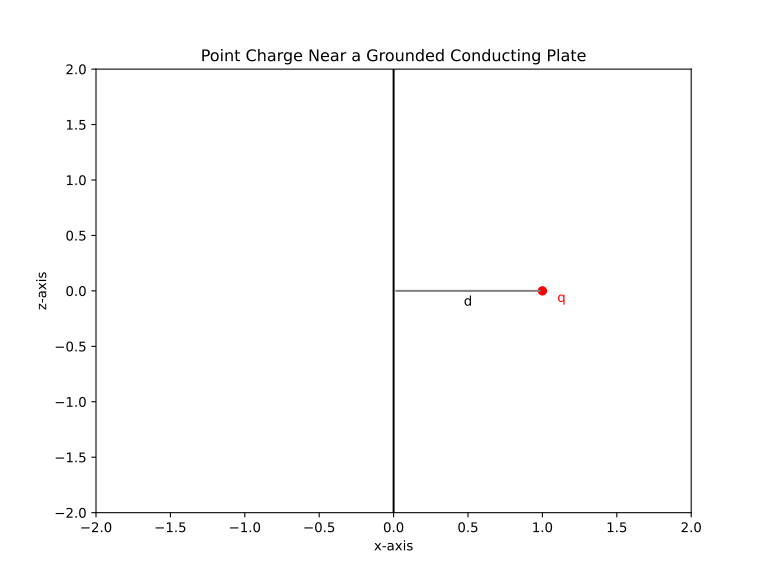
One of the first things to jump out of this problem is the boundry conditions.
\[ \tag{1} V(x, y, z)|_{z=0} = 0 \] \[ \tag{2} V(x, y, z \rightarrow{} \infty{}) = 0 \]
Since there is no real symmetry at the moment to take advantage of, it seems like you might just have to resort solving directly from Maxwell's equations (Gauss' Law) using the boundry value problems to obtain \( V(\vec{r})\)
\[ \vec{\nabla{}} \cdot{} \vec{E} = \frac{\rho{}}{\epsilon{}_{0}} \] \[ \vec{\nabla{}} \cdot{} -\vec{\nabla{}}V = \frac{\rho{}}{\epsilon{}_{0}} \] \[ \tag{3} \nabla{}^{2}V = -\frac{\rho{}}{\epsilon{}_{0}} \]
While it is true that getting to \((3)\) is a neccessary step in solving these problems as we will come to see later, we will first explore the shortcut we can make in solving this problem just by making a guess. As it is significantly more straightforward. Ignoring the conducting plate for a moment, we may guess the electrostatic potential from the formula for a localized charge
\[ V(\vec{r}) = \frac{1}{4\pi{}\epsilon{}_{0}}\int^{}_{}\frac{\rho{}(\vec{r})}{|\vec{r}-\vec{r}'|}dV' \] \[ V(\vec{r}) = \frac{1}{4\pi{}\epsilon{}_{0}}\int^{}_{}\frac{q\delta{}(\vec{r}-\vec{r}')}{|\vec{r}-\vec{r}'|}dV' \] \[ \tag{4} V(\vec{r}) = \frac{q}{4\pi{}\epsilon{}_{0}|\vec{r}-d\hat{z}|} \]
And while correct for a lone point charge, it fails to account for the boundry condition imposed by the conducting plate \( V(\vec{r})|_{x=0} = 0\)
\[ V(\vec{r}) = \frac{q}{4\pi{}\epsilon{}_{0}\sqrt{x^{2}+y^{2}+(z-d)^{2}}} \] \[ V(\vec{r})|_{z=0} = \frac{q}{4\pi{}\epsilon{}_{0}\sqrt{x^{2}+y^{2}+(0-d)^{2}}} \] \[ = \frac{q}{4\pi{}\epsilon{}_{0}\sqrt{x^{2}+y^{2}+d^{2}}} \hspace{10px} \]
It's apparent here that \( (4)\) fails to satisfy boundry conditions since it is nonzero for all \(x\) and \( y\), we can also see graphically that the field lines hit the conducting plate at all angles.
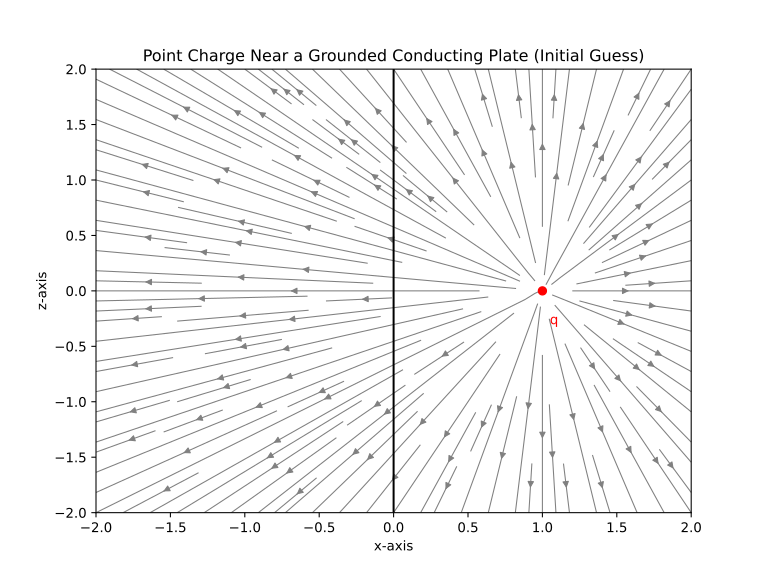
In order for the plate to be an equipotential, i.e. (\( V(\vec{r})|_{x=0} = 0\)). We must find a way for the field lines to hit perpendicular to the conducting plate. Fortunately, by "placing" a second charge, we can impose this condition. One might be able to guess where we may be able to place this charge. Formally, this is what is known as the image charge \( q_{I}\). With a distance \( a_{I}\) from the plate at the origin. Fortunately, with boundry conditions \((1)\) and \((2)\), we may obtain these unknowns.
\[ V(\vec{r}) = \frac{q}{4\pi{}\epsilon{}_{0}\sqrt{x^{2}+y^{2}+(z-d)^{2}}} + \frac{q_{I}}{4\pi{}\epsilon{}_{0}\sqrt{x^{2}+y^{2}+(z+a_{I})^{2}}} \] \[ V(\vec{r})|_{z=0} = 0 = \frac{q}{4\pi{}\epsilon{}_{0}\sqrt{x^2+y^{2}+d^{2}}} + \frac{q_{I}}{4\pi{}\epsilon{}_{0}\sqrt{x^{2}+y^{2}+a_{I}^{2}}} \] \[ 0 = \frac{q}{\sqrt{y^{2}+z^{2}-2zd+d^{2}}} + \frac{q_{I}}{\sqrt{y^{2}+z^{2}+2za_{I}+a_{I}^{2}}} \]
From here, we can determine that \( q = -q_{I}\), and \( a = a_{I} \) leaving us with the solution, by figure 3.
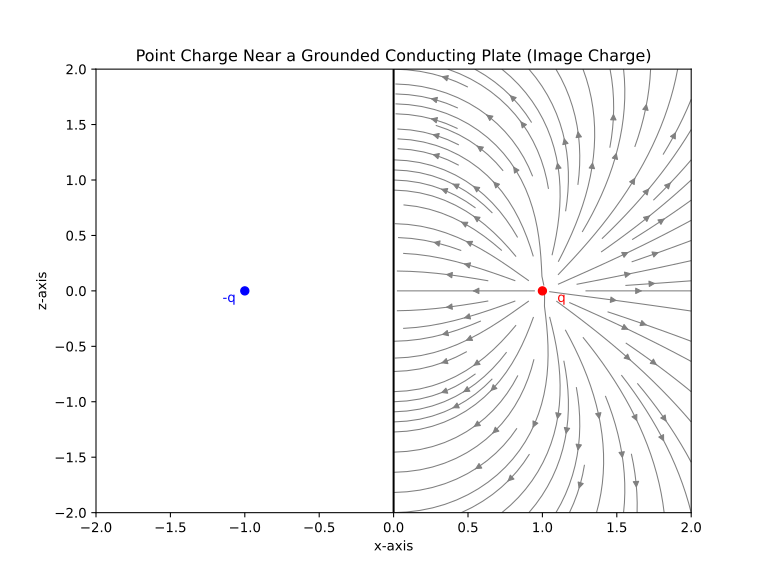
I cannot stress enough that this charge is not in any way Physical, merely a method to ensure that the field lines are orthogonal to the conducting plate, as is the goal with this method. It's for this same reason that I have decided to draw only field lines where this solution is defined within its boundry conditions.
\[ V(\vec{r}) = \frac{q}{4\pi{}\epsilon{}_{0}\sqrt{x^{2}+y^{2}+(z-d)^{2}}} -\frac{q}{4\pi{}\epsilon{}_{0}\sqrt{x^{2}+y^{2}+(z+d)^{2}}} \]
Somewhat trivially, one could solve for the electric field using the identity \( \vec{E} = \vec{\nabla{}}V\), leaving us with the desired answer. For most people, that's enough, there are plenty of problems like this that you may solve in the same setup, and for the most part, it's pretty effective.
But if you take a moment to look back through this line of reasoning, it's not particularly rigorus, and doesn't really seem to explain much of what's happening in this system. Moreover, harder problems seem to have less obvious answers as to where you might need to place these image charges. So why does this work?
Green's Function in Free Space
We may start with a seemingly unrelated discussion solving differential equations in a very general case, suppose we are given a very general formula for the a forced differential equation, where the 'forced' term comes from the function \( f(x) \), it's common to think about it as the function driving the dynamics of the system.
\[ \mathcal{L}u(x) := \alpha{}(x)\frac{d^{2}}{dx^{2}}u(x) + \beta{}\frac{d}{dx}u(x) + \gamma{}u(x) = f(x) \]
Of course, this cannot be solved in general, but interestingly, there is a somewhat simpler way to find the answer given a specific \( \alpha{} \), \( \beta{} \), and \( \gamma{} \). That is, we can try to make f(x) the simplest function to work with. In this case, you might think to use the delta function \( f(x) = \delta{}(x) \). This is exactly what George Green thought to do in 1828, and so came about the Green's function.
\[ \mathcal{L}G(x) = \delta{}(x-x_{0}) \]
And he'd found out that when you integrate this Green's function against the forcing term, you get your original equation back.
\[ \mathcal{L}u(x) = \mathcal{L} \left[ \int_{a}^{b}G(x,x_{0})f(x_{0})dx_{0} \right] \] \[ = \int_{a}^{b}[\mathcal{L}G(x,x_{0})]f(x_{0})dx_{0} \] \[ = \int_{a}^{b}\delta(x-x_{0})f(x_{0})dx_{0} \] \[ = f(x) \] Which is also written as, \[ u(x) = \int_{a}^{b}G(x;x_{0})f(x_{0})dx_{0} \] As a side note, it's perfectly fine to switch between \( ;\) and \( , \) since the parameterization or extra dimension of \( x_{0} \) are treated based on its use. This function proves to be extremely useful. So long as you know the Green's function, you have your solution. If we now look back to \( (3) \), we might see how we may be able to solve this equation in general \[ \tag{5} \nabla{}^{2}u(\vec{x}) = -F(\vec{x}) \] Of course, in electrostatics \( u(\vec{x}) = V(\vec{x}) \), and \( F(\vec{x}) = \frac{\rho{}(\vec{x})}{\epsilon{}_{0}} \).
This Green's function is known, when we look at the fundamental solution to the Poisson equation \[ \tag{6} \nabla{}^{2}G_{n}(\vec{x};\vec{y}) = \delta{}^{(n)}(\vec{x}-\vec{y}) \] Since we are working in multiple dimensions, the notation and solution are a little more rigorus. I will briefly explain what we are looking at. The \( G_{n}(\vec{x};\vec{y}) \) and \( \delta{}^{(n)}(\vec{x}-\vec{y}) \) functions represent a multivariate form of the single variable Greens' function and Dirac delta function respectively, defined as: \[ G_{n}(\vec{x};\vec{y}) = G_{n}(|\vec{x} - \vec{y}|) \] \[ \delta{}^{(n)}(\vec{x}-\vec{y}) = \prod_{k=1}^{k}\delta{}(x_{k}-y_{k}) \]
To solve \( (3) \) we will integrate over some arbitrary surface, choosing a ball of radius \(r\) centered on \( \vec{y}\) for simplicity's' sake \[ B_{r} = \{ \vec{x}\in{}\mathbb{R}^{n} : |\vec{x}-\vec{y}|\leq{}r \} \] \[ \int_{B_{r}}\nabla{}^{2}G_{n}(\vec{x};\vec{y})dV = \int_{B_{r}}\delta{}^{(n)}(\vec{x}-\vec{y})dV \] By Stoke's theorem, we can turn our volume integral into a surface integral, we also know that integrating the delta function in any setting gives 1. \[ \int_{\partial{}B_{r}}\nabla{}G_{n}(\vec{r};\vec{y})\cdot{}\hat{n}dS = 1 \] Because of the spherical symmetry of the boundry, we know that \( \hat{n} = \hat{r} \) and so we are only concerned with the derivative of \( G_{n} \) in the radial direction. Since we are only concerned with spheres in 3-dimensions for now, \( dS = r^{2}d\Omega{}_{3} = r^{2}sin\theta{}d\theta{}d\phi{}\). \[ \int_{\partial{}B_{r}}\frac{\partial{}G_{3}(\vec{x};\vec{y})}{\partial{}r} r^{2}d\Omega{}_{3} = 1 \] \[ \frac{\partial{}G_{3}(\vec{r})}{\partial{}r} r^{2}\int_{\partial{}B_{r}}\Omega{}_{3} = 1 \] Here, without all the formality, the integral is simply an integral over angles of a simple sphere. So, \[ \frac{\partial{}G_{3}(\vec{r})}{\partial{}r} 4\pi{}r^{2} = 1 \] \[ \frac{\partial{}G_{3}(\vec{r})}{\partial{}r} = \frac{1}{4\pi{}r^{2}} \] Is now reduced to a separable ODE. One might note that this property explains the factor of \( 4\pi{} \) in the couloumb force. Integrating with respect to \(r\) and using the relation \( r = |\vec{x}-\vec{y}|\). We will get the free-space Green's function solution. \[ \tag{7} G_{3}(\vec{x};\vec{y})= -\frac{1}{4\pi{}|\vec{x}-\vec{y}|} \] One might note that this solution is an important component in the electric potential, and describes clearly where this factor of \( 4\pi{}\) comes from. And shows that this solution holds in general based on equation \( (3) \) (Gauss' Law).
Green's Function in Half-Space
If we now limit the space in which we are able to solve this differential equation to the positive half of the real number plane, i.e. imposing boundry conditions \( (1) \) and \( (2) \). We of course know now that this free space solution will not work with the boundry conditon \( (2) \) from our discussion of \( (4) \). However, by making the same guess as we did with the image charge, it is clear from our motivating problem that this guess will in fact work.
\[ G_{3}(\vec{r};\vec{y}) = \frac{1}{4\pi{}\epsilon{}_{0}\sqrt{x^{2}+y^{2}+(z-y)^{2}}} + \frac{1}{4\pi{}\epsilon{}_{0}\sqrt{x^{2}+y^{2}+(z+y)^{2}}} \]
With this, the underlying mathematics does require a guess, there is no nice way of solving this kind of problem without it. However, there are many cases in which this general method can give you a better idea on what exactly might need to be added in order to satisfy these boundry conditions. And helps simplify the problem to solving for a distance variable. Where you may then apply the physical properties of this problem using Gauss' law to then determine the charge, often from boundry the boundry condition \( (1) \). Meaning similar problems can be reduced to finding the correct Green's function. Which I hope to come back to in a later post.- Skinner, D. (n.d.). Green’s functions for PDEs. Cambridge University, 126–142.